A Beginner’s Tale
 |
Written by Richard Martin In 2004 I wrote an account for the UK storytelling magazine Facts & Fiction of how as an Englishman based in Germany I had become a teller of traditional folk tales to adult audiences. The article provided the occasion to look back on what had happened and what I had learnt. As befits a wonder tale, much was by coincidence and good fortune. However, I quickly learnt the need for organisation, and perhaps more slowly learnt the need to learn the art. Now Eric Wolf’s invitation serves as a chance to update that review, especially regarding any learning. |
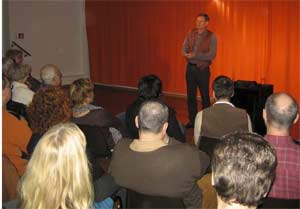
Back in 1990, I had never told a story to a public audience before, let alone to a public audience of non-native speakers. But I was asked to put together a two-hour show with a group of musicians who played medieval music – and walked out to see 200 adults sitting there. Admittedly, working here as a teacher and teacher-trainer I had always told stories to my classes in the school where I worked – which was why the musicians invited me. But with 200 to perform to, this was for real!
That night I learnt three things all storytellers soon discover. One, that working with an audience is where you really learn about performing. Two, that storytelling is very like sex and drugs: once you have started, it is very difficult to stop. But three, that if you want to tell stories, you need to have people to listen to you – and so you need to organise.
Organisation
Fortunately I live in a country where a reasonable knowledge of English is fairly widespread within the general population. Furthermore, the language and most things English have a high acceptance. So once I discovered to my surprise that I was launched on the road to becoming a storyteller, I had to begin to look for listeners.
I soon found that there is a potential for storytelling to adults in English over here, but that it takes a lot of hard promotional work to turn that potential into gigs. Most listeners who come to a storytelling event in English-speaking countries probably come because they are interested primarily in the stories. Most who come to hear me (at least for the first time) probably come because they are interested primarily in the English language. So my task was first to convince organisers who knew little about storytelling that this was really what they needed – but that is a situation familiar to many tellers even in their own country! At least I like to think that when the audience return to another performance perhaps a year later, they also come for the power of the stories.
The first eight or so years took a lot of hard organisational work – and all in pre-internet days: finding addresses, phoning people who had never heard of either me or storytelling, discovering what promotional material to print, sending mail shots, etc. But many readers will know about that side of things – including learning the delicate art of discussing fees.
Gradually this organisational side of being a storyteller became a lot easier, in part due to having a great webmaster who has created my first professional website as a labour of love and a contribution to the art of storytelling (although he had little idea of how much he was letting himself in for when he generously offered this over a glass of wine after a performance).
But what about the art?
At the start I was in the dangerous position of being a storyteller before I had had the opportunity to discover much about the art I was meant to be practicing. With no training in either storytelling or drama, I had only heard a very few tellers and knew just a few tales. Yet when I was invited to tell, I naively jumped at the chance. That the listeners obviously liked the performance was flattering – but also dangerous; at first it was tempting to listen to the applause and assume that this was all there was to storytelling.
However, as I realised on that first night, working with an audience is a wonderful way of learning how to perform. As a beginner I was lucky to have a wide variety of audiences to learn from – and slowly to learn that there was a lot more I needed to know about both the art of telling and traditional tales. Not that this has always been a smooth learning curve. At least once successful self-promotion managed to get me onto a stage which was arguably a bit beyond where I should have been – as in 1995 when I talked my way into performing at Beyond the Border. (At least the audience liked me even if more experienced tellers saw the gaps which I was just beginning to see.)
With the expansion of the internet, learning more about the art also became easier. Joining the Storytell listserv first put me in touch with many storytellers whose understanding was not only much greater than mine but who were always generous with help. The discussions there taught me much about traditional tales, taught me to re-think some of what I had been doing – made me sensitive to the art and power of storytelling. Soon I was no longer isolated but meeting others to learn from.
And here in Germany, although the storytelling scene had long been very contentious (Martin Ellrodt’s website gives an introduction to this), the situation has developed very positively in the last decade. Young and talented tellers are becoming full-time professionals. Storytelling festivals have sprung up and attract audiences spanning the generations. The bi-annual ZauberWort (MagicWord) festival in Nuremberg is just one sign of this optimistic trend.
So in 2004, after the initial years of learning in virtual isolation, I at last had the support of a community. And there was more fairytale good fortune – the English teaching scene in Europe and Asia began to recognise the pedagogical value or storytelling, leading to plenty of teacher-training workshop opportunities for me to combine my two professions.
Update
Looking back from the perspective of 2011, while the good fortune has definitely continued, the organisational lessons have slightly changed. Apart from word-of-mouth, a storyteller’s chief promotional asset is clearly a website – yet if a website is merely there to promote, it will fail. Visitors will only be attracted by real storytelling content, primarily that means stories. So visitors need resources they can use and a website architecture which is easily navigable so that content can be found. My own site has undergone two complete rebuilds in an effort to do that.
Similarly, I notice a changed perspective in my artistic direction. The early years were more directed towards the “how”, learning the art of holding an audience. Now my focus is perhaps more on the “what”, on the content of the story. Many years ago the UK storyteller Hugh Lupton told me his aim was to become transparent on stage, to enable the listener to move through the teller into the world of the story. Then I understood this more in terms of performance techniques to draw the audience into the storytelling trance. Today I am equally aware of the need for the content to be strong enough to construct a world which is worth the listeners entering. It is here that the European preference for telling traditional folk tales nourishes me as a storyteller.
So storytelling in English in Germany? It has been a long tale and sometimes pretty hard work – but definitely a tale worth telling!
For more information on this writer go to his website at: www.tellatale.eu
Tags: European Storytelling, German Storytellers
 Extra Articles | Brother Wolf |
  March 29, 2011 4:25 pm