Christine Carlton and Jenni Cargill – 2 Australian Storytellers – Examining the Skeletons in the Cultural Closet.

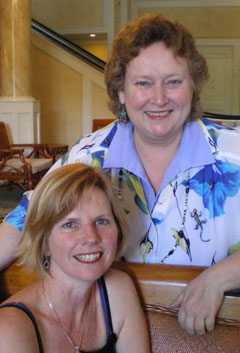
Press Play to hear Christine Carlton and Jenni Cargill have a conversation on Australian Storytelling on the Art of Storytelling with Brother Wolf.
 |
|
||||
Written by Jenni Cargill-Strong
Eric asked what does it mean to be Australian? Ask 20 different Australians these questions and you might get 20 different answers.
Christine explained and I’d agree, that it can be hard to define the Australian identity, because we have such a diversity of cultures. Many Australians arrived in recent decades since World War 2. The Aboriginal population is less than 2% and most Aborigines live in isolated inland rural areas, whereas most Australians live in cities on the coast, so most Australians don’t have much direct contact with Aboriginal people or culture.
I would agree with Christine now that yes, if you were to generalize, as a people, we are mostly laconic, relaxed, friendly and we have a great sense of humor. Like any country, we also have our shadow, our racism and unresolved issues. However at least Aboriginal issues are much more on the table to be openly discussed now, our Prime Minister gave the apology* to the stolen generation** that many of us had been waiting for and progress is slowly happening with land rights.
Despite all the struggles of Aboriginal Australians, as we both mention in the interview, we now have not only very strong traditional Aboriginal art, dance and storytelling, but the most wonderful flowering of contemporary Aboriginal dance, film, art, theatre and even comedy that keeps building momentum.
I loved Eric’s’ reference to -the elephant in the room’. The apology was an important step in our national history and in the development of our identity, because it acknowledged one of the big elephants that had been sitting in the room of the Australian psyche ““ the facts and the pain of the stolen generation.
I feel that stories that connect us to country are also very important, especially in the context of the level of social dislocation and the state of the environment. A Maori*** friend told me about the Maori concept of your -tangata whenua’ which translates to your lineage and the land you come from or -the ground you stand on’. It makes you stronger to clearly know and claim who you come from and the land you come from. She said in traditional Maori culture, you get shown the plot where you’ll be buried when you are young and you visit that spot regularly, so you also know the ground you’ll end up in.
In Australia, this national sense of -the ground we stand on’ is still evolving. So when you ask a non-Aboriginal Australian to tell an Australian story, it’s not as straight forward as it may be for an Aboriginal person, a Celtic person, a Hawaiian person or a Japanese person- assuming each of these people are still have connected to their cultural stories.
Non-indigenous Americans must face similar issues, but I imagine since you’ve been there a few hundred years longer and you have a larger body of American folktales to draw from. New stories are slowly emerging in Australia, woven from and reflecting the many cultural strands that make us up. The version Christine told of -Stone Soup’ is a great example. I am currently working on a new collection of environmental stories to record that reflect connection to country, connection the Earth and connection to the rhythms and the seasons.
The gift of our Australian situation is that we are not weighed down by any rigid traditions– so many strands to weave with and we have much room to evolve, experiment and discover. Let the adventure continue!
The Apology’ refers to the speech our current Prime Minister, Kevin Rudd made in 2007 to acknowledge and apologize for the pain and suffering created for the stolen generation by government removal policies.
The Stolen Generation is a group of Australian Aboriginals who were taken from their families according to Australian government policy between 1910 and 1970. While it is unclear exactly how many children were taken from their homes, some estimate that the numbers could be between 1/3 and 1/10 of all Indigenous Australian children born during that time.” See more at http://www.actnow.com.au/Issues/Stolen_Generations.aspx
*** Indigenous people from New Zealand. Moari’s refer to their country as Aotearoa (pronounced Ow-tay-ah-row-ah), which means -Land of the long white cloud.
For people interested in Australian Aboriginal films, there have been some amazing films that have come out of the Australian Aboriginal community like “Samson and Delilah’; Rabbit Proof Fence’ and -Ten Canoes’. If you come to Australia and you are interested in Aboriginal culture, I recommend in particular that you check out “The Dreaming Festival” which happens in our winter on the east coast see www.thedreamingfestival.com.au
Jenni Cargill-Strong
www.storytree.com.au
Christine Carlton
President NSW Storytelling Guild, Australia
http://www.storytellersnsw.org.au/

Bio
Jenni Cargill-Strong, Director of the Storytree Company is a storyteller with unbridled enthusiasm and passion for her art. Teachers often remark after a show, that students who seldom listen well, sit spellbound. Jenni employs a wide repertoire of dramatic skills and a beautiful singing voice to hold her audience. Her training includes a Bachelor of Arts in English Literature and Sociology from the University of Queensland, classical singing training and a diploma from the Drama Action Centre in Sydney. There she studied clowning, improvisation, dance, singing, mask, mummers, percussion and workshop facilitation specialising in storytelling. Her professional experience was gained in over twelve hundred schools in Australia and New Zealand.
Jenni’s first CD “Wonder Tales of Earth and Sea” claimed a special award from the National Library of Australia and she has now two new albums: “The Mermaid’s Shoes” and “Stories to Light the Dark”. She has performed for ABC national radio as well as ABC TV’s ‘7.30 Report’. She has performed and presented workshops for the Bennelong Program at the Sydney Opera House, The Powerhouse Museum, the National Storytelling conference, the Woodford Folk Festival since 1993, Byron Bay Adult Community Education and The Byron Bay Writers Festival 2004.

Bio
Christine Carlton believes in the power of Storytelling to engage, affirm and transform the human spirit. For more than twenty years Christine has worked as a freelance Consultant, Facilitator and Educator in the areas of Story, Drama and Creative Arts in Education, Business and Community Development.
She travels throughout Australia and overseas offering a variety of opportunities for individuals and organisations to tap into their own creativity to gain insight and direction for their lives and their communities.
Christine lectures in Story and Drama in Education at the University of Western Sydney , facilitates leadership and team-building processes, offers teacher in service, storytelling workshops, reflective retreats and is regularly called upon to provide creative leadership and group facilitation at national and international conferences.
Currently she is president of the Australian Storytelling Guild (NSW), a member of Australasian Facilitators Network, Australian Institute of Professional Facilitators and a number of professional associations that support and promote the transforming power of Storytelling.
 Episode List, Healing Storytelling, International Storytelling, Professional Development, Storytelling in Community | Brother Wolf |
  November 18, 2009 11:27 pm



By Charles Johnson, November 25, 2009 @ 12:54 pm
This was a great episode, I just finished listening to it in my car.
I’d like to hear more from both of them, but I would especially like to hear more about the development of infrastructure in Australia – it’s almost like going back in time to watch the development of American professional storytelling.