Anne Glover on Finding Your Authentic Voice in Storytelling

Press Play to hear Anne Glover speak about Finding Your Authentic Voice in Storytelling on the Art of Storytelling.
 |
|
||||
Anne Glover writes….
Here are two things I feel passionately about in storytelling: authentic voice, and connection to the audience. They are closely intertwined. Some people think “authentic voice” means “no character voices.” If you’ve heard my dialogues with the character “Monkey,” you know that I use character voices, particularly for comedic episodes, as Eric learned when he interviewed me. (Have you recovered yet, Eric?) But when I use those other voices, I make a clear distinction in my voice, my brain, and my body between the character and my narrator.
As both a performer and a listener, I prefer a natural voice for the narrator persona. Sometimes as tellers, we think we need to be doing “more.” We alter our voice, add more breath, and drop to a different register, as if “storytelling” required something other than our true selves. It doesn’t. In fact, it demands that each of us bring our true self to the fore, without letting our ego get in the way of the story. This requires that we constantly watch ourselves and our deep intentions, with ferocious honesty.
Sometimes we get so wrapped in the notion that storytelling requires a special voice, that we get in the way of the story. Some people want to know how to “find” their authentic voice. Here’s a technique I like. I might say, for instance, “Bob, tell me what your story is about. Don’t tell the story. Just tell me what it”s about.” And Bob says, “Well, it’s about this guy who (blah blah blah)” – So far, Bob is using a normal conversational voice. Then he gets caught up in the story and he starts telling it: he gives more detail, and – most significantly – his voice changes. All of a sudden, he’s using a “special” voice, extra breath in his speech, and maybe he’s changed to a different register and volume.
What I want is for storytellers to find that conversational, relaxed voice, and develop a working relationship with it. I’m not saying it’s all we should use. But it should be part of our repertoire. I want storytellers to be comfortable being themselves, using their own voice, along with whatever else they use. Think about what our voice carries, along with the story. It carries, in invisible code, a message of how much we trust ourselves (and therefore the audience) with our true self.
Connection with the audience is essential to storytelling, and it’s alarmingly easy to lose. There will be surprises and concerns: “I thought there would be 300 high school kids – what are all these pre-schoolers doing here?? And why isn’t my mic working and is my fly zipped?” Dealing with all this is an art in itself. But knowing our authentic voice and being comfortable with it will keep us real and connected to this audience (as opposed to the audience we thought we’d have, or the audience we had last time, or the audience we wish we had). If we have that authentic connection, we can reach our audience.
©2009 Creative Commons A Glover and Brother Wolf Storytelling (Nonderivative Noncommercial use only)
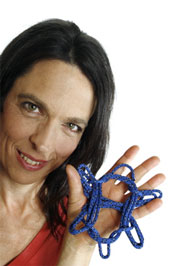
More about Anne…
Anne Glover is an entertainer and consultant based in Victoria, BC. She has spent years enchanting audiences with her stories and string games and inspiring educators with her innovative approaches to education. Anne has appeared at countless schools, festivals, and conferences across the continent, and has performed her original stories on CBC radio, in both English and French. She is a polished, engaging entertainer with a humorous wisdom and an infectious enthusiasm for life in any language. Anne Glover’s Website.
Tags: Arts in Schools, Canadian Storytellers, Comedy, Schools Programs, Storytelling for Children, Storytelling Techniques
 Beginning Storytelling Tips, Episode List, International Storytelling, Professional Development, Storytelling in Community, Storytelling in Schools | Brother Wolf |
  September 3, 2009 11:03 am



By Norah, September 9, 2009 @ 12:58 am
Thanks for this – amen! As Dale Pendell said in short poem:
The first thing
the last thing
Start from where you are.
“…knowing our authentic voice and being comfortable with it will keep us real and connected to this audience (as opposed to the audience we thought we’d have, or the audience we had last time, or the audience we wish we had). If we have that authentic connection, we can reach our audience.”
By Bob Linsenmayer, September 6, 2010 @ 11:46 am
I have attended dozens of storytelling workshops over the years, but when I listen to the Art of Storytelling on my iPod as I take my early morning walks, my storytelling education grows expediently. I just listened to the excellent interview of Anne Glover, which was full of valuable ideas, and I am now anxious to try out some of her tips when I next face an audience that is not responding as well as expected to my stories.
By Pamela Hanks, September 15, 2010 @ 2:02 pm
A few years ago I began collecting Camilla Gryski’s string books. I thought I would incorporate some into my stories. While I’ve heard of storytellers doing that, I had not, until now seen one do it. I love you website and your promo video. I was delighted to find that I had more than one of the books you recommended on string games on my shelf. I think it is time I dust them off and hunt down the string that came with them. My son, who loves to do the string games, will be delighted for me to do some with him again.
If there was one thing that I would love to know that I haven’t learned yet from you, it would be…how long is the string you use when you share stories in large audiences?
I also think you are right on when you talk about connecting to an audience.
By Dave, October 29, 2010 @ 3:16 pm
I am way, way behind on listening to Eric’s podcasts, but I just listened to this one. “Monkey” was so funny, but I was particularly interested in Anne’s discussion about the voice of the storyteller. I just delivered a story at the launch of my new storytelling enterprise (in a nutshell: true stories told by real people) and I was told I sounded natural (and, of course, it’s what I strove for), but I didn’t FEEL like I was sounding natural. At some point, I guess it comes down to trusting what others are saying, but it would be nice if there were some tips on how to recognize when you do and don’t sound natural (self-analysis while you are talking).
Thanks Brother Wolf!
Dave
By Brother Wolf, November 2, 2010 @ 12:35 am
I had a great deal of fun recording this interview and I really look forward to seeing Monkey perform again someday…