photo by: Simon Brooks
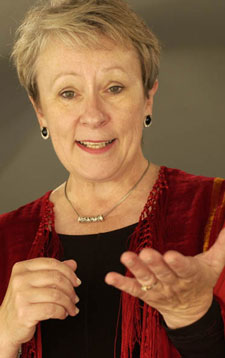
Yvonne Zinicola ( Rt.) with Lanes President Joanne Piazzi and President- Elect Tony Toledo
Written by Carolyn Stearns
This is part two of two of my interview of Yvonne Zinicola our Lanes Exec. Director. Now more than a year into her position we look at where we have come from and where she sees Lanes going. 8. What gem have you found since you began with Lanes?
I know it sounds repetitive, but our members and our volunteers are the largest gems of LANES! The sheer dedication of our board members and our volunteers from bloggers to event volunteers to others, amazing! Our members are VERY supportive of each other and travel about visiting each other’s venues. It’s a wonderful network of people.
9. Anything coming up you want to share about?
The board will be revamping the Strategic Plan before June 2012 and by then we should start to see more of the plan’s implementation for which we have been building the foundation. Truly getting into promoting storytelling is what we want to benefit the whole storytelling community.
10. New York is the next host state, how is the planning going?Read more »
Written for by Carolyn Stearns… Part 1- An Interview With Lanes Exec. Director Yvonne Zinicola as of 3-29-2011
I requested to interview Yvonne for the blog as a way of capturing her first year and reflecting on its impact with Lanes and storytelling in the Northeast. I sent Yvonne my questions and we thought of putting out this interview prior to Sharing the Fire. My questions got Yvonne to thinking and they needed time for the answers to gel while STF day was racing forward. We decided after everyone was home from Sharing the Fire and the light had simmered to red coals it would be a good time to release the interview. I decided to post it as received in the question answer format and not try to fix something that doesn’t need fixing.
Yvonne has had a year to get to know us and we are all beginning to see who Yvonne is. Hopefully for those who have not yet had the pleasure this will bring you a little overview. For all those who have met or worked with Yvonne already, here is some follow up to what you have been introduced to.
1. 1 year has passed, what is just as you expected in that time frame?
I really do not set “expectations” until I have a chance to understand the organization, its members and its systems. The first year was exploratory and foundation building. Although I am new to Storytelling, I am not new to the arts and have over 15 years experience in Non-profit management. First, I had to do an in depth assessment of the organization to determine our strengths and weaknesses. The framework of processes was in place, but I had to add much more detail. That’s not really unusual for a non-profit that has been pretty much staffed by volunteers with some part-time admin folks along the way. So it was no surprise, but it has taken much time and energy. In order to move forward, it was vital to our work to do this foundation building.
2. What in the year has most surprised you?
I was surprised and amazed by the passion and dedication that our storytellers have. We have an amazing group of vibrant members who are dedicated to each other as much as to furthering the art of storytelling. I was impressed at the many functional, creative and inventive ways that storytelling is being used to make the world a better place and to create understanding between people.
3. Where have you seen the most progress?Read more »
Tired of the tin sound?
Purchase a HQ Mp3 File of Interview #025
Onawumi Jean Moss
[wp_eStore:product_id:46:end] for $2.23
Using culturally driven objects to create entertaining storytelling festivals.
Onawumi Jean Moss is an deep storyteller to draw from with her rich history on college campus and with her commitment to storytelling. She brings a solid grounding to the often airy art form of storytelling. I hope you enjoy listening to our interview as much as I enjoyed recording it.
More on Onawumi Jean Moss…
Onawumi Jean Moss of Amherst, Massachusetts is a storyteller, narrator, keynote speaker and author. Onawumi is a 2005 recipient of the Zora Neale Hurston Storytelling Award (November 2005), the highest award given by the National Association of Black Storytellers (NABS). She holds lifetime memberships in the National Storytellers Network (NSN) and the National Association of Black Storytellers (NABS). She is also a member of the League for the Advancement of New England Storytelling (LANES).
The performances of this talking book and rhythm master encourage pride of heritage, appreciation of cultural differences and recognition of kinship. This Tennessee native’s first stories were learned from her Read more »
Purchase a HQ Mp3 File of Interview #014 Carol Birch
[wp_eStore:product_id:35:end] for $2.23
Copyright issues and storytelling.
Carol Birch writes… “More opportunities equal more responsibilities” is a simple explanation of copyright. As a librarian, I can read or tell stories to children in the library or as part of a school visit. Fair use also permits me to tell stories in classrooms where I teach graduate students. Responsibilities change when I’m hired as a storyteller, then acting ethically means seeking permission. However, Catch 22’s abound.
Clearing performance rights is the first thing to do, when seriously considering a story penned by another. Unfortunately, the first thing publishers and agents ask for are the date(s) and time(s) a story is to be performed. And who knows?
For more information on this topic, listen to the podcast and read an article that will be published in UP FOR DISCUSSION in School Library Journal, August, 2007. We’ve got to work together to establish some precedents to which we can all refer when we contact publishers.

 Extra Articles, Festival Storytelling, Professional Development | Brother Wolf |
  July 14, 2011 3:36 pm |
  Comments (0)